The unknown is another way of describing the possible
I'm sitting in a small room with bottles of developing chemicals, trays, tongs, and a small group of photography students at Photographic Center Northwest sometime around 2016 or 2017, and we're discussing the artist Yves Klein.
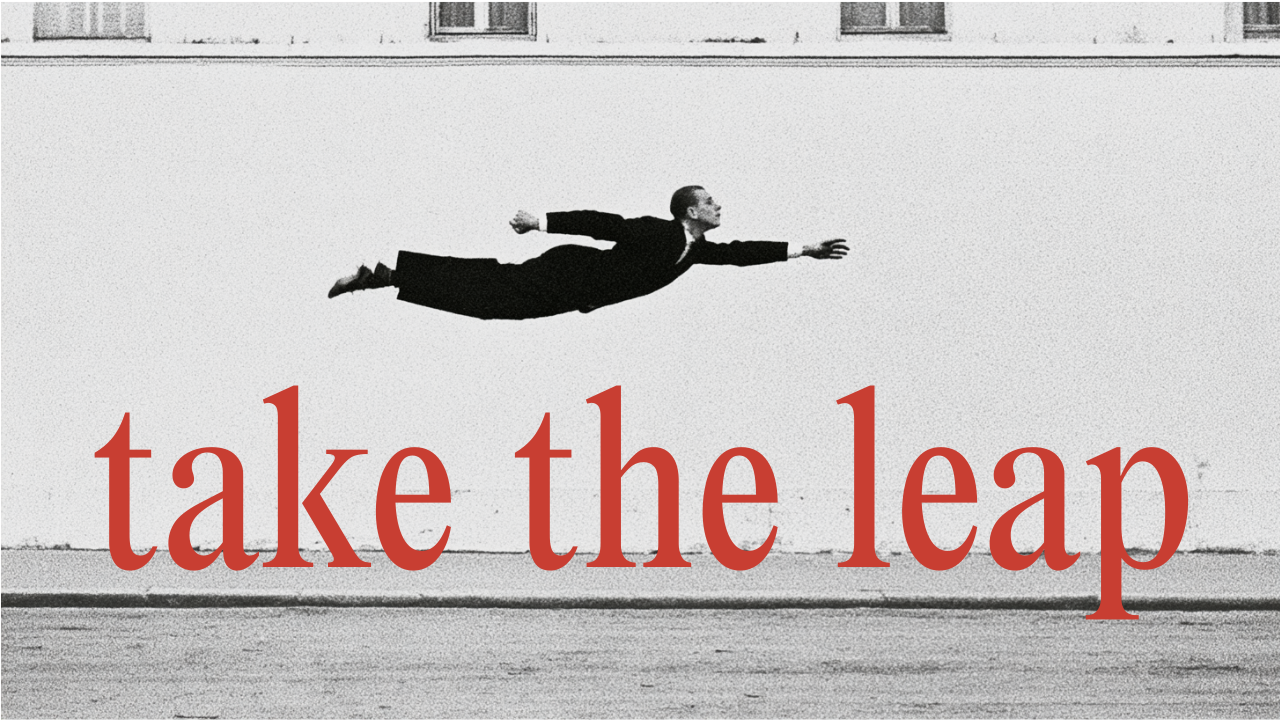
Klein created a very famous photograph, Leap Into The Void, in 1960, and in it you can see a man in free fall from the second floor. He hangs in the air with an eager expression. His intention is tangible. He damn well wants to be there. His chin is lifted, he's looking forward, almost as if he's about to take a swimming stroke. You think: "does he know he can't fly?" And I remember almost believing it — that here is a human being who has cracked the code and can actually fly. Because there is a conviction in his presence.
And it's at once beautiful. Dreamy. And then it also presses on the tender place inside you that says: "ouch, how naive. Imagine, he actually believes it himself."
But how he lands remains unknown. And that is precisely the photograph's appeal. Its magic, one is tempted to say.
My photography teacher explained to us that the image is actually composed of two photographs. Because the actual production involved a group of people standing on the street with a tarp to catch him. And then they of course took a photograph of that same setting without the necessary safety net on the street, which was then carefully stitched together with precisely that shot of the man hanging in the air, gracefully, forcefully.
Do you know the feeling of looking back at moments in your life and seeing yourself as the man hanging in the air? Have you, like me, looked back at periods of your life and shuddered at the thought: "imagine, I actually dared to do that!"
Have you perhaps reflected on whether you still have the same courage — because just the thought of what you once threw yourself into gives you goosebumps now?
I imagine most people would agree that it's important to dare to take the leap, to stay with the visual metaphor. We celebrate people who show courage, who dare to forge a path where no one has walked before. Because once the leap is taken, we no longer focus on whether it was reckless, but instead on what it brought.
We know this. It's powerful to be courageous.
But when we stand there, in our own lives, and sense an opportunity to throw ourselves into deep water, as it's also called. Or to take a chance that we can feel brings us closer to who we are, what we believe in, and that is more in line with the life we actually dream of — we hesitate. And often we do nothing at all. We are paralysed.
It's an interesting paradox.
Several times in my life I have experienced it as standing stretched out, like an elastic band between two poles. Two places I can choose to go.
One place is where I have stayed for a long time, what I know. Where everything is as it usually is.
The other place I can only sense through the tension it releases. I can feel it pulling at me, but I have absolutely no idea what I'll find there.
But I still feel stretched all the way out, and sometimes I'm on the verge of breaking. It can be painful. Almost completely unbearable. Because in that state, you're neither here nor there.
And that's what I see in the photograph. A man who has decided to move toward the pole where everything is unknown. And he has chosen this with elevated pride and great eagerness.
In the work of mapping out a method for finding the courage to dare to move into the unknown — even with elevated pride and great eagerness — I've thought a lot about how we change the language we use when we talk about this.
We often use words along the lines of having a direction, a goal, of dreaming about something, about a puzzle where the pieces finally fall into place. We talk about the discomfort of not being able to know where the destination ends, or whether we can reach the result we want.
I've noticed that there seems to be an idea of a specific outcome, a specific place we need to find, or a specific coherence that will reveal itself to us once we set a new course in our lives. It's as if we need to see a precise goal in front of us in order to move into something new. At least in the way we talk about it.
So I've come to think that the whole problem is that we will never be able to say with certainty what we're moving toward, if we set out on a new course in life.
We think it's the exact destination we need to point our compass at, but I've become convinced that the only thing we can point our compass toward is our own conviction about the overall direction. And then everything else will reveal itself as we move in that direction.
And that's why there is a truth in that photograph. Because the man who leaps doesn't seem driven by reaching a specific destination, but by leaping. And it's striking that he isn't confused or searching. He is very convincing in his way of hanging there in the air, because what matters most is that he is in motion, and has moved away from what was before.
I'm very preoccupied with picking apart the idea that we absolutely must end up somewhere specific.
I felt myself stretched all the way out between staying in a certain kind of work, in a certain industry, when — coming out of an incredibly bad experience of returning to that very same industry and role after becoming a mother — I simply couldn't see how I would ever find joy in it again. As so many have experienced, I found myself in a situation, a kind of defining experience, that radically changed what felt meaningful to me.
And then, at the same time, a longing began to emerge toward something new, something different. I could feel an enormous urge to test what I was made of in a completely new way than what I’d ever done before. There were sides of myself, I thought, that I very much wanted to bring into action. Well, there was perhaps almost an entirely different Helene hiding inside me. Maybe the Helene I had always longed to dare to be?
But I was unable to act for a long time.
And when I finally began to say it out loud to myself or, trembling, to others, I set a very precise course for exactly how my transformation would unfold.
I specified my precise vision, my new role and my path there fairly quickly, and phew, then it was actually okay to take steps in that direction.
In reality, I don't feel at all like I took a proper leap. I see it more as if I found a map that others had drawn. And sure, the map was new to me, but the destination was already charted.
And you've probably guessed that sooner or later I could no longer deceive myself and continue the illusion that I had in fact thrown myself out, freely, of the window. I began again to long for something more indefinable, but something I could mostly identify as loose sketches, feelings and moods inside me.
Fortunately I could sense my self-deception honestly. I had to feel it. Perhaps because once you've committed to wanting a new path, you've still taken a small, important step, even if it isn't the perfect step. Maybe it's even the case that it's precisely part of the development that you first have to stumble over yourself?
Right now I'm reading James Hollis, who is a Jungian psychotherapist. And he talks about the fact that boldness is the most important thing there is. That showing courage, being driven by boldness, is the highest thing we can do, and is what triggers meaningfulness. He cites Jung's powerful words:
"Only boldness can deliver us from fear. If the risk is not taken, the meaning of life is violated."
Hollis points out that we almost die when our lives are guided by fear. When we sacrifice what we should be developing into, in order to remain in safety. We die when we consciously choose convenience over following the mystery that calls to us, even though it is monumentally inconvenient.
So, back to the photograph of Klein. It is ultimate in its visualisation of courage, I think.
Because the photograph doesn't show courage as something that has to do with knowing exactly what to do. But as what happens when you trust something in yourself enough to act on it.
Klein's photograph illustrates that certainty is not the prerequisite for courage. It is the opposite of courage. That certainty, we can throw in the garbage bin.
Because courage is not certainty.
In fact, following certainty is being in a place where we cut ourselves off from what is possible. Because in certainty, we know everything. There is no room for what could become.
But courage is to aim toward what could happen, what could be possible. And therefore we must move away from certainty and set ourselves in motion. It is the only way into new possibilities.
Like choosing to leap into the unknown — not because you know what awaits, but because the unknown contains everything that is possible.